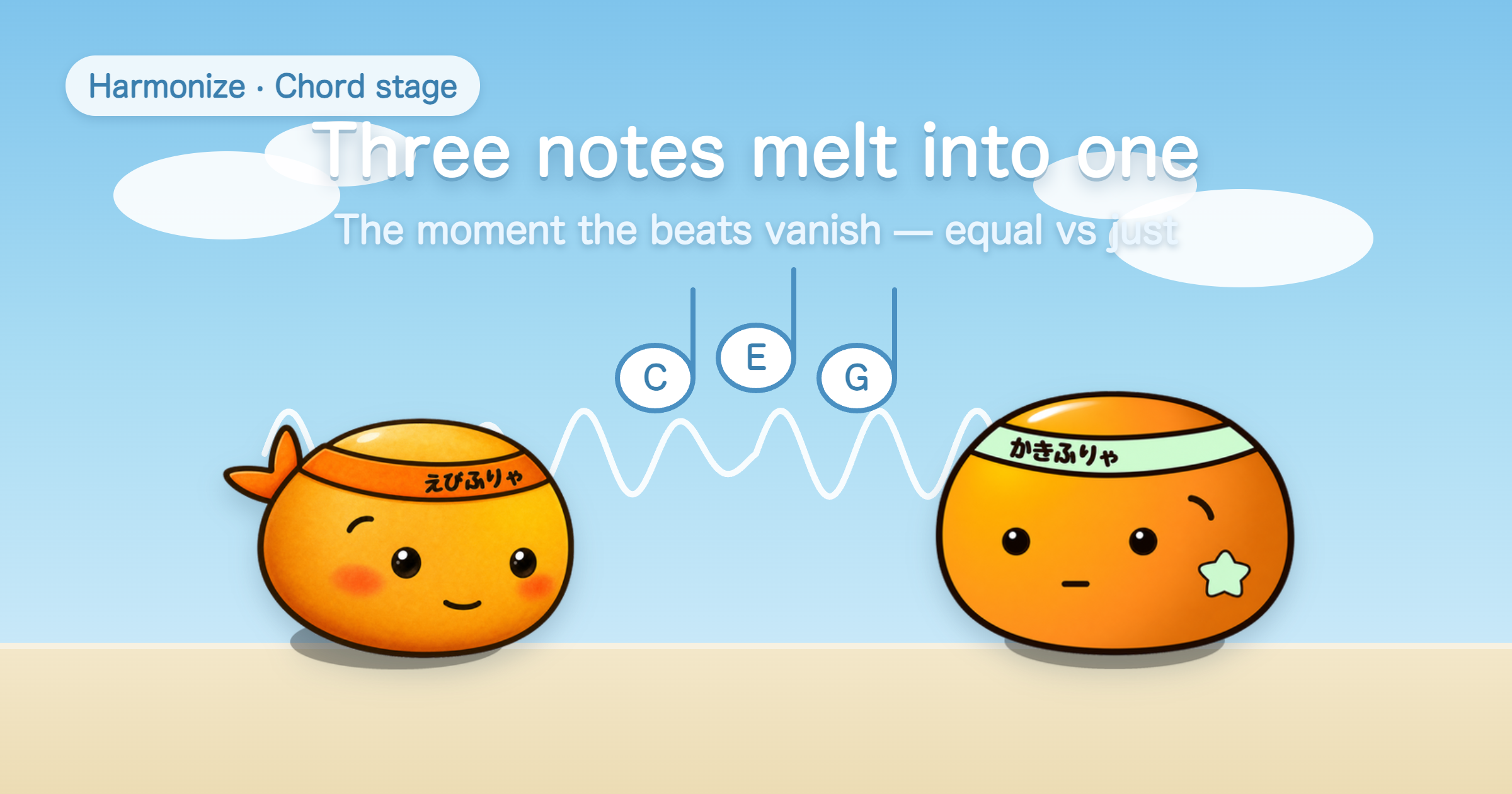
Playing the chord stage in Harmonize, you keep meeting a certain moment.
As you nudge your own note little by little, the sound that was throbbing “wah-wah” suddenly goes quiet at one spot. The seams between the three notes disappear, and they melt into a single pillar of sound.
What is your ear catching in that instant? And here is the twist — that clean, blended sound is something a piano literally cannot produce. Let’s talk about why.
The “wah-wah” is two notes fighting
Play two notes whose pitches differ slightly at the same time, and the volume swells and shrinks in a steady cycle. That is beating.
The two waves keep reinforcing each other and then canceling out, and that cycle becomes the swell of the volume. The number of beats equals the difference in frequency between the two notes. 440 Hz and 442 Hz give exactly two “wah"s per second.
A piano tuner counts these by ear while adjusting the strings. Pressing “slow” in Harmonize to make the beats easier to hear is the very same work a professional tuner does.
A chord that locks sits on simple whole-number ratios
The beating drops away sharply when the overtones of the two notes line up exactly.
- Octave … frequency ratio 2:1
- Perfect fifth (C and G) … 3:2
- Major third (C and E) … 5:4
When the ratio is this clean, the two overtone series fall on the same spots and the sound fuses into one. This is the idea behind just intonation. A clean-blending chord is, physically, “overtones landing on top of one another.”
And yet the piano compromises
Modern pianos are not tuned in just intonation. They use equal temperament, which splits the octave into twelve equal steps.
The equal-tempered major third (C to E) is about 14 cents — roughly 14% of a semitone — wider than the pure 5:4. So whenever you play a “C–E–G” on a piano, the E is always a touch sharp and the chord keeps beating faintly. You don’t notice, because your ears are used to it, but this is not a tuning error. It is by design.
Why accept the compromise? Because just intonation makes “C–E–G in C major” perfect, but the moment you change key the ratios break and other keys turn badly out of tune. Equal temperament trades “perfect in one key” for “decent in every key” — the historical bargain keyboards struck to win the freedom to modulate.
Listen for yourself (demo)
Ears beat words. Compare the same “C–E–G” in equal temperament and in just intonation below. Isolating the major third makes the difference in beating clearest. Watch the waveform, too: equal temperament throbs up and down, while just intonation flattens toward a steady line.
If it doesn’t display, open the demo in a new tab . (The demo controls are labeled in Japanese, but the two play buttons are simply equal temperament and just intonation.)
Even just intonation is never perfectly clean
Let me be honest here. Switching to just intonation does not make every beat disappear.
What disappears is the beating between the lower overtones that hold the chord up — the part your ear is most sensitive to. That is the layer that clicks into place when you feel it “lock” in the game. But a real instrument’s tone carries a great many high overtones, and once you include those, things get messier. Strings are slightly inharmonic because of their stiffness (pianos especially so), and no performance is perfectly in tune. Lining up the very highest components exactly is impossible — in equal temperament and just intonation alike.
The interesting part is that this “never perfectly clean” isn’t necessarily a flaw. If you built C–E–G out of pure sine waves alone, there would be almost no beating — but the sound would be thin and frail. It is the overtones bumping and shimmering slightly that make a chord thick and alive. A choir, or a section of unison strings, sounds lush precisely because many slightly different sources overlap and shimmer — something close to a chorus effect. Just intonation doesn’t create a sterile perfection; it creates a sound whose foundation is clean while the upper floors stay pleasantly busy.
What voices and strings can do, and a piano can’t
Instruments that can slide their pitch freely — the human voice, strings, brass — can adjust each note inside a chord, unlike a piano. Fine choirs and string quartets take the third slightly lower to lean into a pure blend. The same “E” on the page is tuned differently depending on its role in the chord. It is why unaccompanied choral singing can sound startlingly clean: the singers are leaning into that zero-beat blend in real time.
What you were doing in the game
So the ear work in Harmonize’s chord stage — listening into the beats, hunting for the single spot where the sound dissolves — is the same kind of listening a choir or a string quartet does on stage. You were tuning, by ear, a chord clean all the way down to its foundation — one a piano keyboard cannot produce.
Next time you open the chord stage, stop just short of the answer and listen to the beats slow down: ten per second, then five, then one, and then the beating of the foundation quietly vanishes. That last step is the 14-cent distance between equal temperament and just intonation.
The chord stage unlocks once you collect stars in the double-stop and chord modes. If you’d like to train your relative pitch by chasing that moment where the beating disappears, give it a try.