The Scale stage in Harmonize plays you a melody, and you rebuild it note by note, tuning each pitch by ear. Somewhere along the way you may have wondered: what exactly is the “correct” pitch the game is checking me against?
The natural guess is equal temperament — the tuning of pianos and tuner apps. Or, if you have read the chord-stage article , you might guess just intonation, the tuning where beats disappear. It is neither. The Scale stage places its targets on a third ruler: Pythagorean tuning.
Why bring in a third ruler at all? Because of a genuinely interesting property of music: what counts as “in tune” for a chord and what counts as “in tune” for a melody are not the same thing.
The same “E,” but chords and melodies disagree
Just intonation, the hero of the chord stage, puts notes at simple whole-number frequency ratios. C and E at 5:4 — the beats vanish and the sound melts into one.
But take that chord-perfect E and sing it inside a rising scale, and to most ears it sounds slightly flat, as if it were sagging. Do the opposite — play a chord using the brighter E that sounds alive in a melody — and the chord starts beating and turns muddy. Same note name, different correct pitch, depending on whether it lives in harmony or in melody.
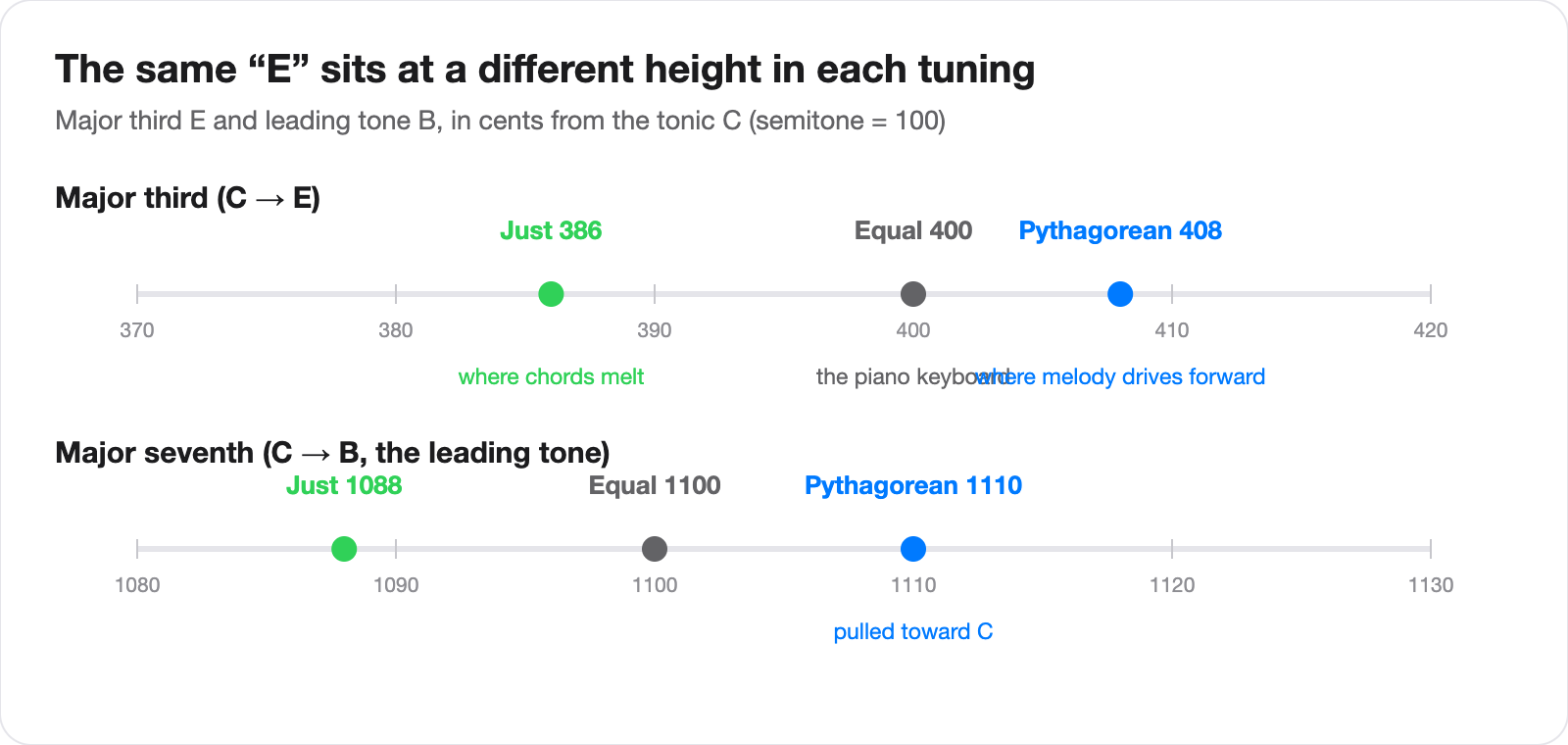
The unit in the figure is the cent — one hundredth of a semitone. The just-intonation E sits 386 cents above the tonic, the piano’s E at 400, the Pythagorean E at 408. The whole spread is 22 cents, about a fifth of a semitone, yet ears pick it up reliably. String players and choral singers are taught exactly this: take the third low in a chord, high in a melody.
And when a good player performs an unaccompanied melody, the pitches they naturally settle on are the ones Pythagorean tuning predicts. The Scale stage is melody practice, so that is where its answers live.
Pythagorean tuning: stacking fifths, nothing else
Pythagorean tuning is credited to Pythagoras of ancient Greece (around the 6th century BC) and is the oldest tuning theory on record. The recipe is almost comically simple. You use one ingredient — the perfect fifth, frequency ratio 3:2, or 702 cents — and you stack it.
Start at C and go up a fifth: G. Up another fifth: D (fold it back inside the octave and it lands at 204 cents). Keep going: A (906), E (1608, folded back to 408), B (1110). F is the one exception, built by going down a fifth from C instead (498). That gives you all seven notes of the major scale.
The scale built this way has a distinct personality. Whole tones (C to D) are 204 cents, a touch wider than equal temperament’s 200. Semitones (E–F and B–C) are 90 cents — noticeably narrow. The star of the show is the seventh note, B, the leading tone: at 1110 cents it is the highest B of the three tunings, sitting only 90 cents below the tonic C above it.
That combination — a high leading tone and narrow semitones — is what gives melody its sense of drive. B leans so close to C that it begs to resolve there. The way violinists and singers instinctively shade their intonation in an unaccompanied line (musicians call it melodic intonation) matches this 2,500-year-old arithmetic almost exactly, which is quietly moving when you think about it.
Harmonize, by the way, switches rulers per stage: the chord and arpeggio stages use just intonation, where sounds melt; the Scale stage uses Pythagorean tuning, where lines move. Play them back to back and your ear gets to experience both kinds of “correct.” (The absolute position of the key itself — where the tonic sits — follows your reference-pitch setting in equal temperament, so nothing clashes if you play along with other instruments.)
The scales in the game
Here is the roster of the Scale stage, one staff at a time. Every category is practiced not only from Do: the game rotates the starting note (from Re, from Mi, and so on) and quizzes you both ascending and descending. The notation below shows each scale’s basic form, one octave from C.
Major scale — the reference point
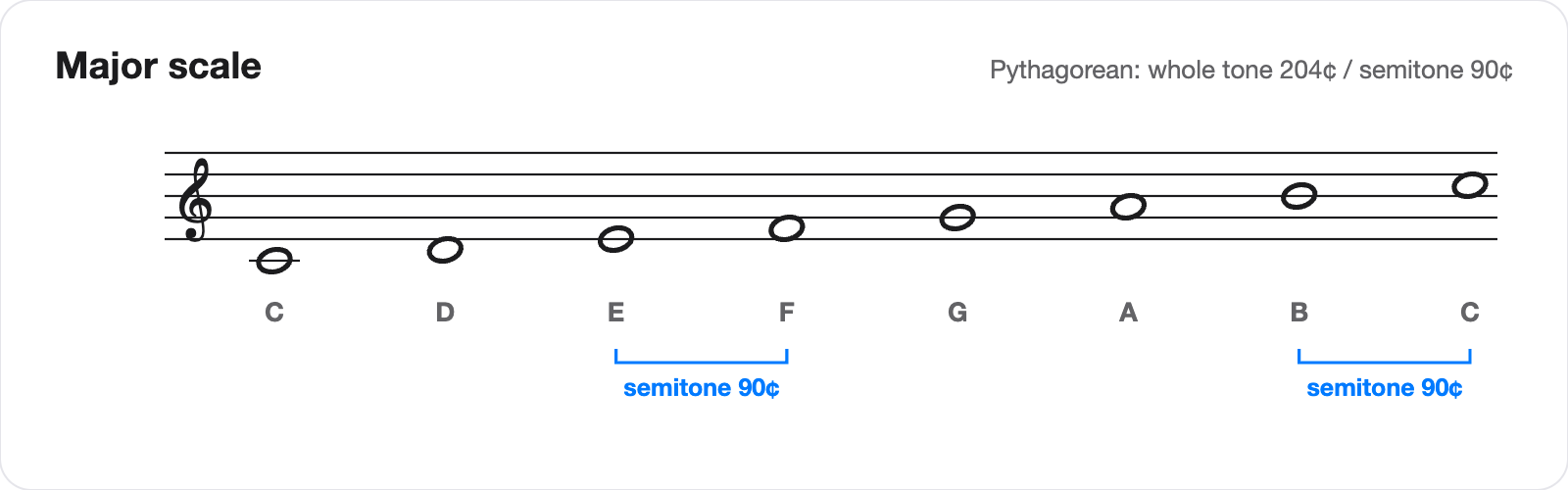
The familiar bright do-re-mi. Its defining feature is where the semitones fall: only between E–F and B–C. In Pythagorean tuning those semitones are a narrow 90 cents, which makes the final step from B up to C feel like coming home.
Things get interesting when you change the starting note. The same seven notes, started from D, take on a wistful color — this is the world of the old church modes (starting on D gives you Dorian), still everyday vocabulary in jazz and game music. The “start from each note” exercises quietly walk your ear through the whole modal family.
Harmonic minor — the exotic leap
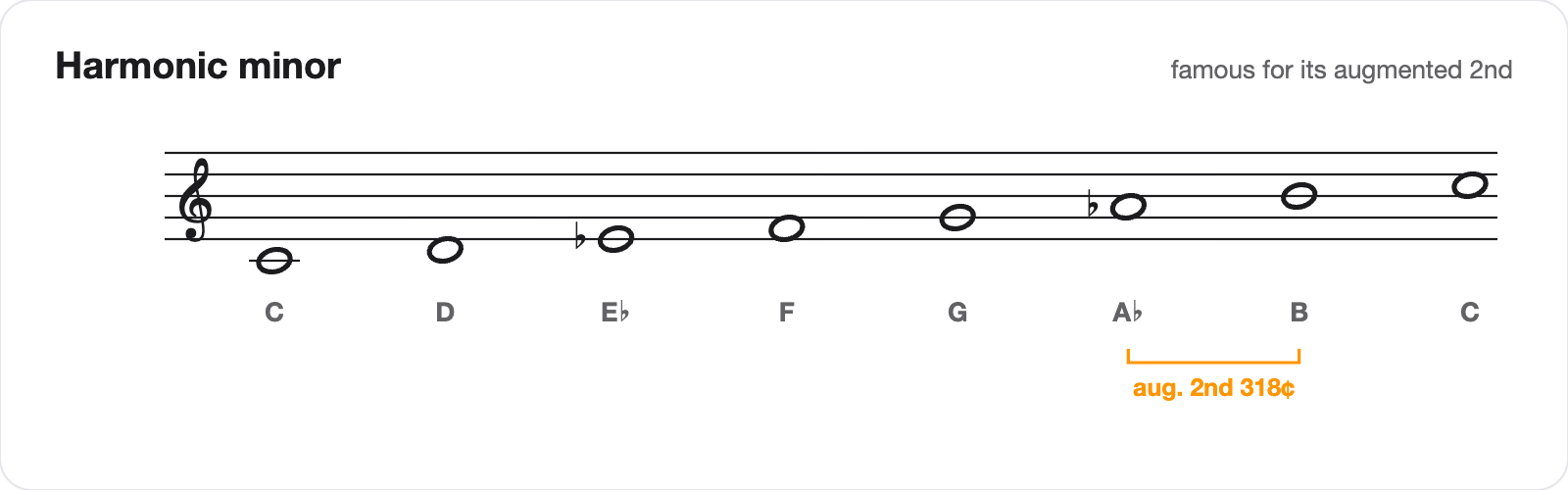
A minor scale, engineered: the seventh note is raised purely because the music wanted a leading tone. The price is a gap of 318 cents — an augmented second, a step and a half — between A♭ and B. That leap is the source of the scale’s much-described “Arabian” perfume. A scale built for a technical reason ended up with one of the strongest personalities of all.
Melodic minor — a different shape up and down
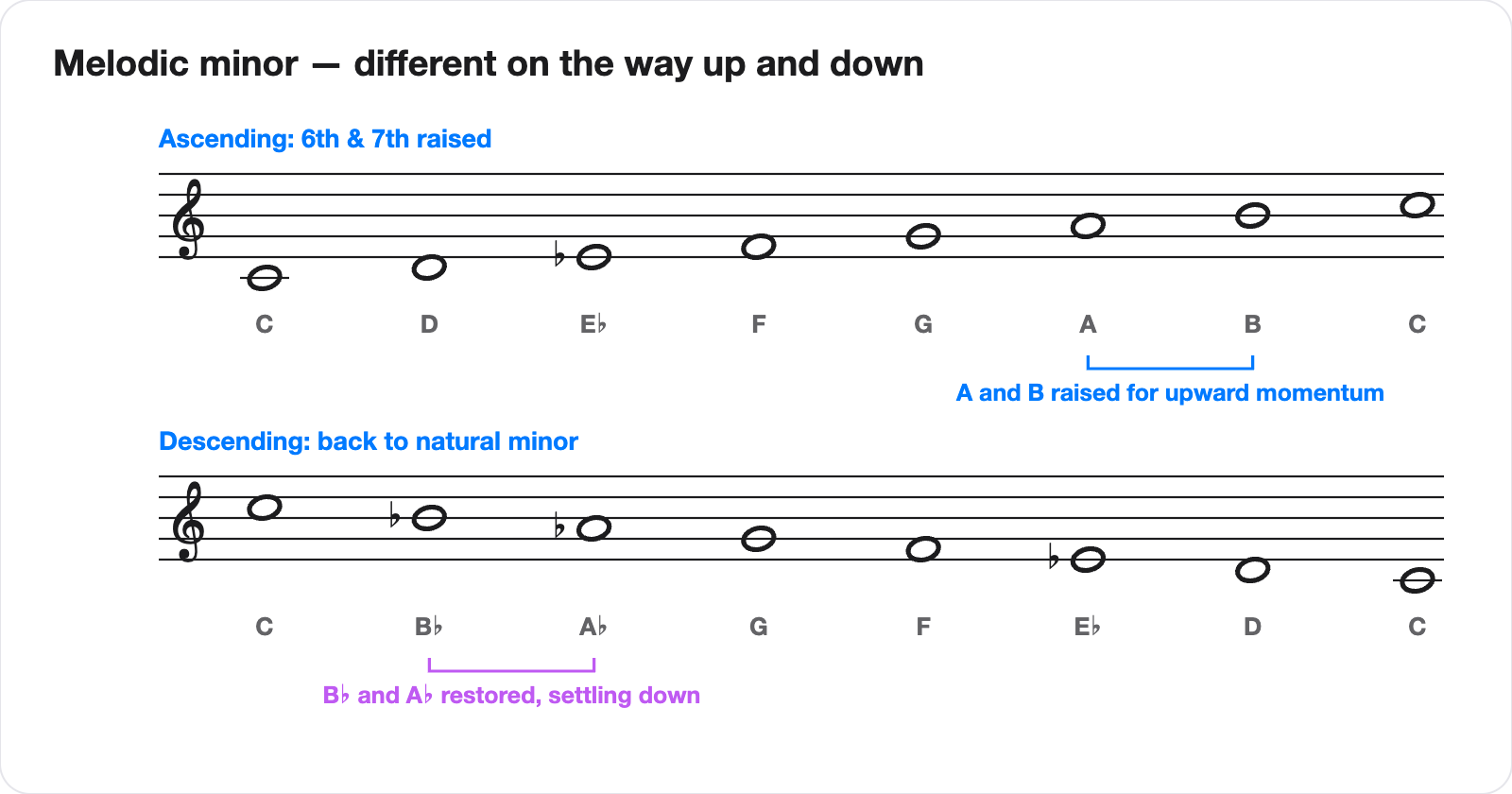
The harmonic minor’s augmented second is awkward to sing. So on the way up, the sixth note is raised as well, smoothing the path; on the way down, no leading tone is needed, so both notes relax back to the natural minor. It is the only scale in the game whose ascending and descending forms differ — a lovely trap when a descending question arrives and your ear still remembers the way up.
Pentatonic — five notes, no semitones
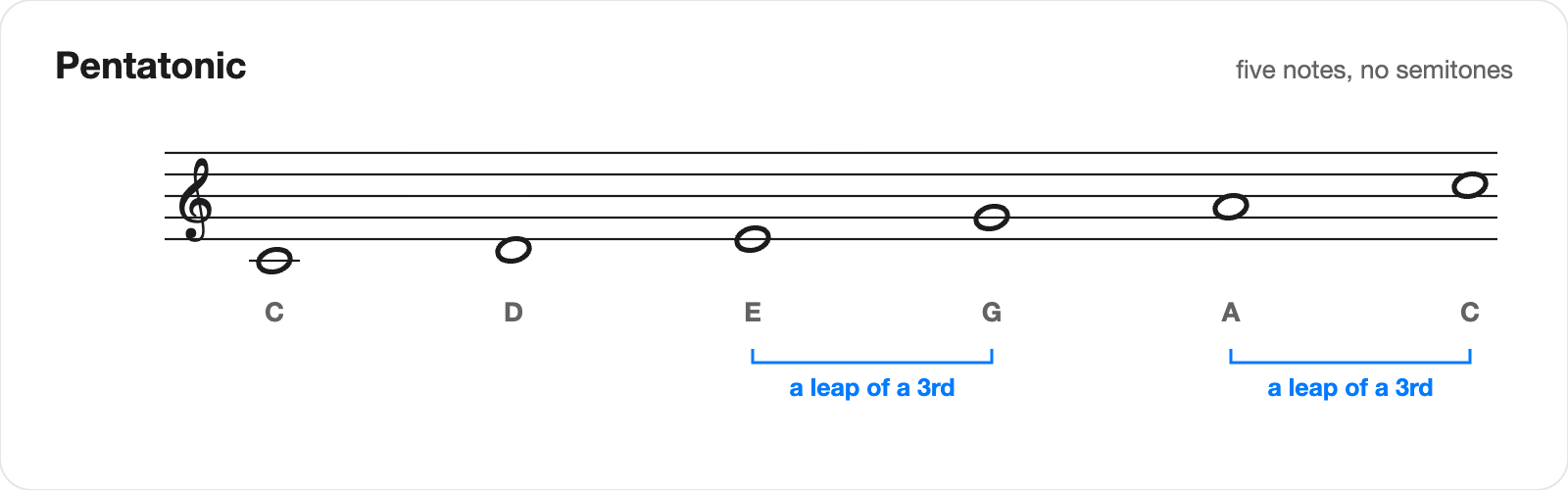
C, D, E, G, A — the major scale with F and B removed, leaving no semitones at all. Since nothing rubs against anything, folk traditions all over the world arrived at this same shape independently: Scottish tunes, Japanese children’s songs, rock guitar solos. Rotate the starting note and it turns from major-bright to minor-dark; both live inside the same five notes.
Ryukyu scale — straight up a major third
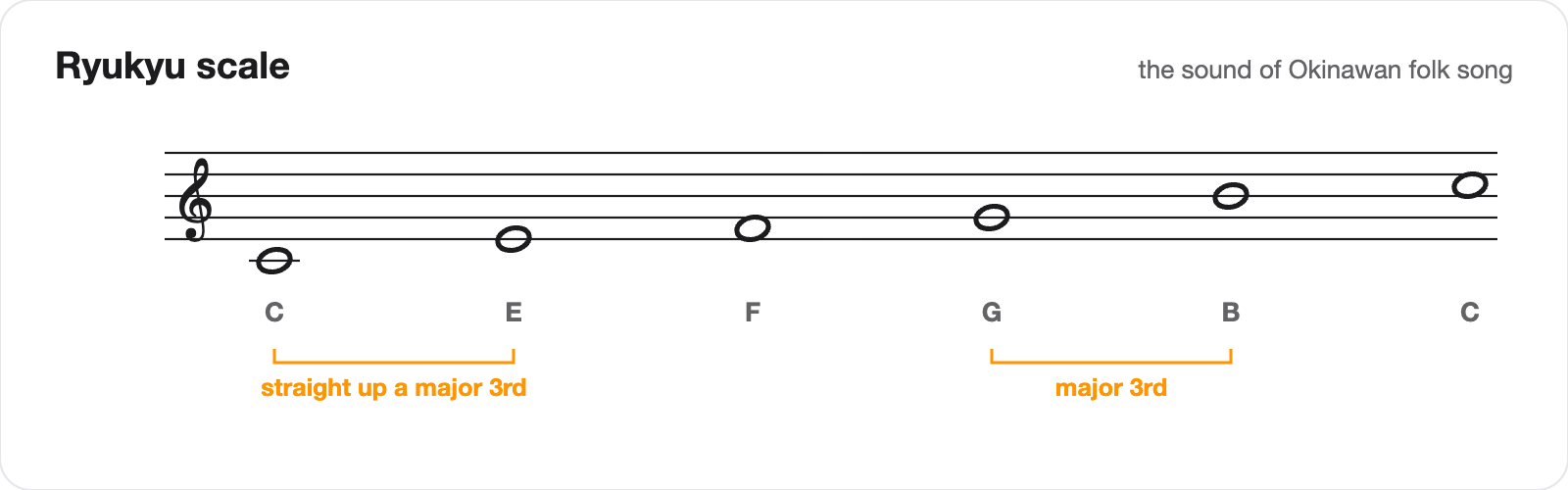
C, E, F, G, B — the unmistakable sound of Okinawan folk music. It skips D entirely and opens with a bold major-third leap from C straight to E. Unlike the mainland pentatonic it contains real semitones (E–F and B–C), and the narrow 90-cent Pythagorean semitone gives them a bright, sunlit snap.
Miyako-bushi — the shadow scale of old Japan
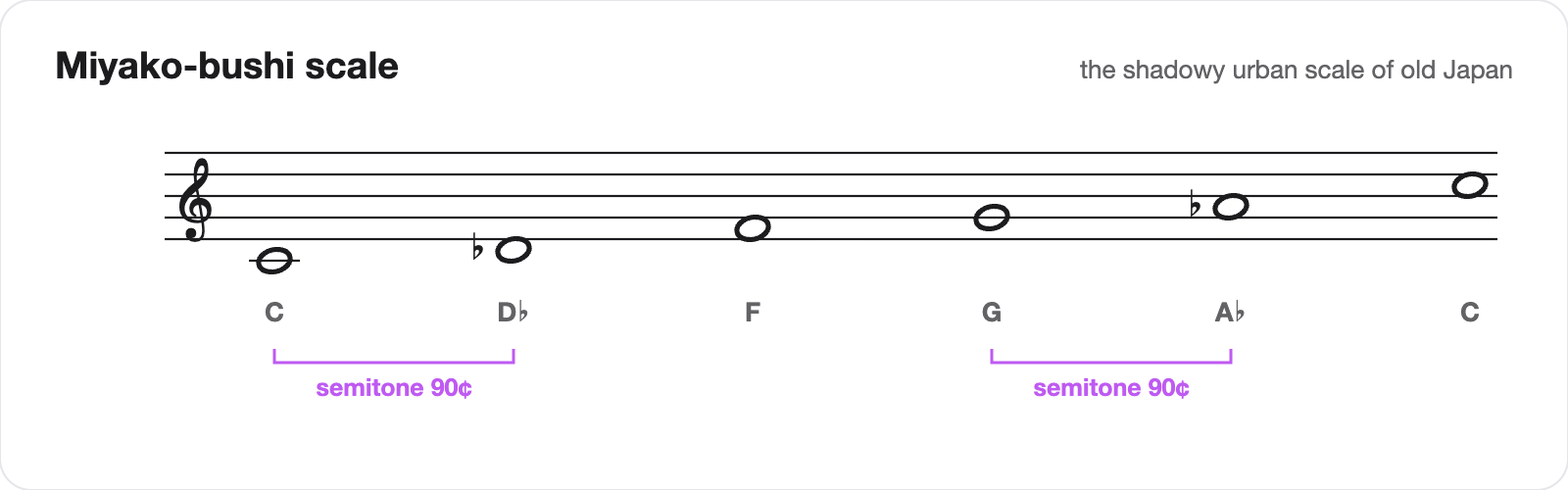
C, D♭, F, G, A♭ — the deeply shaded scale of the shamisen and koto. The D♭ leaning just a semitone above the tonic creates its characteristic humid darkness. It makes a perfect pair with the Ryukyu scale: both are five-note scales with semitones, and simply moving where the semitones sit turns southern sunlight into Edo-period shadow. No other pair in the game shows so clearly how much the placement of intervals matters.
Hungarian minor — two augmented seconds
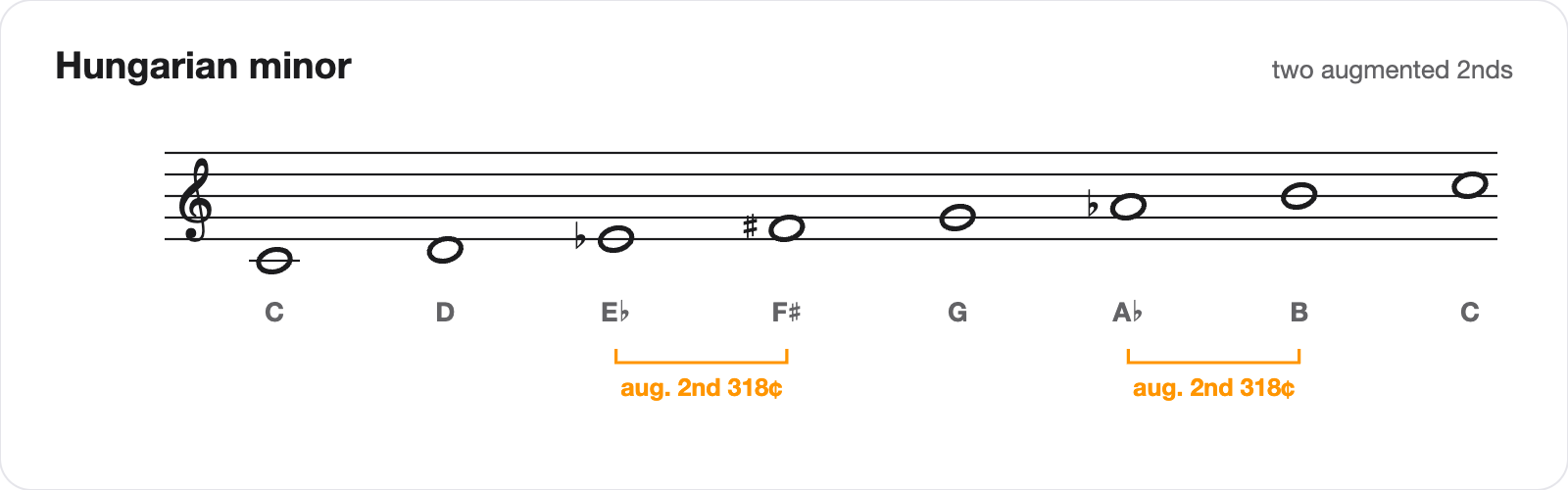
Take the harmonic minor and raise the fourth note too, and you get an augmented second in two places. It is the sound of Eastern European and Romani music, beloved of Liszt and Brahms. One augmented second is already tricky to sing; this scale serves them double, making it one of the most demanding items in the game.
Blues scale — a deliberate intruder
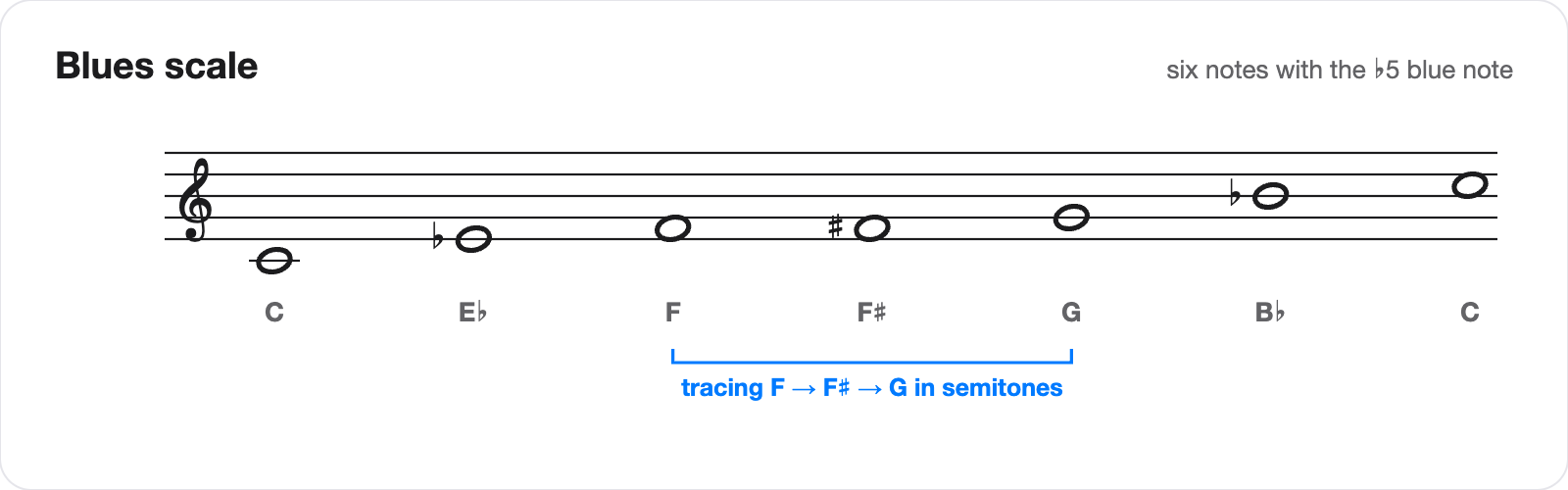
C, E♭, F, F♯, G, B♭. The F♯ wedged in the middle is the blue note. A real blue note is something a voice bends into — a smear that notation can’t quite hold — but if you must pin it to a scale, this is where it goes. In Pythagorean tuning this F♯ lands at 612 cents: the augmented fourth, the interval once nicknamed the devil’s interval. An intruder planted in the middle of a well-behaved tuning, and that discomfort is precisely the flavor of the blues.
Whole-tone scale — weightless
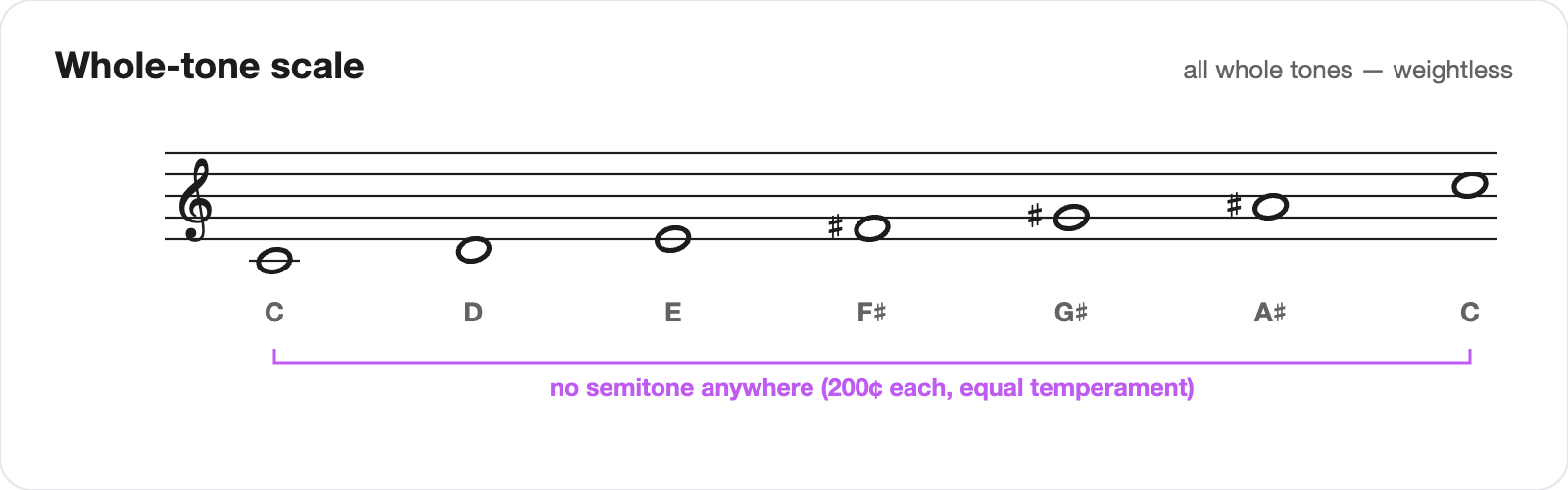
C, D, E, F♯, G♯, A♯ — every neighboring pair a whole tone, perfectly evenly spaced. With no semitone to lean on, the pull of the tonic disappears and the music floats, dreamlike. Debussy made it famous.
One honest disclosure: for this scale alone, the game judges in equal temperament’s 200-cent steps. Stack six Pythagorean whole tones of 204 cents and you get 1224 — you overshoot the octave and the scale refuses to close. A scale whose very idea is “perfectly equal steps” is an equal-temperament creature, so that is how it is tuned.
Chromatic scale — there are actually two kinds of semitone
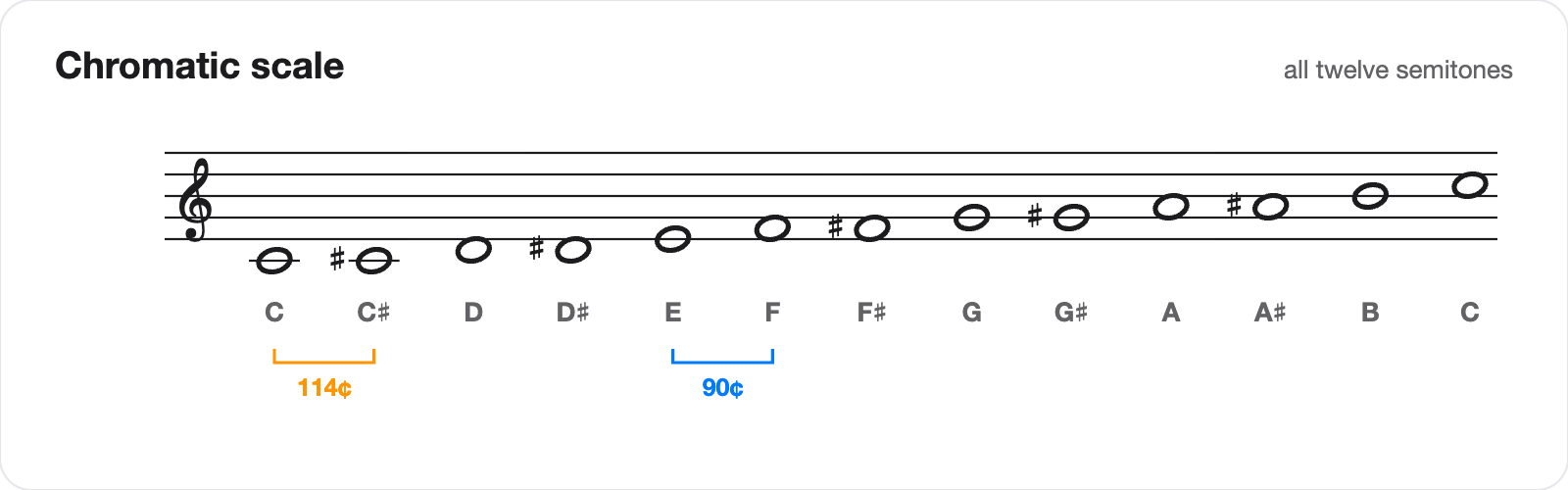
All twelve semitones in a row — the final exam. And here Pythagorean tuning shows its most delightfully nerdy face. In equal temperament every semitone is the same 100 cents. In Pythagorean tuning there are two kinds: the semitone that moves to the next letter name, like E to F, is 90 cents, while the one that sharpens the same letter, like C to C♯, is 114 cents. Same word “semitone” on paper, different stride underfoot.
The chromatic category mixes both kinds, so the sharper your ear, the more you will notice that the steps refuse to be uniform. That is not a bug — it is Pythagorean tuning being honest. The exercises also ramp up gently, starting from semitones you already know (E–F), then three-note cells, five-note blocks, and finally the full twelve.
The ear switches rulers with the context
Equal temperament, just intonation, Pythagorean tuning — none of the three is the single right answer. The piano chose equal temperament to treat all twelve keys fairly; choirs drift toward just intonation to melt their chords; an unaccompanied melody leans Pythagorean. A good musician’s ear swaps rulers on the fly, to fit the moment.
Playing Harmonize’s chord stage and Scale stage back to back lets you feel that swap directly: hunt for the low, melting E in a chord, then minutes later sing the high, driving E in a scale. Once that 22-cent round trip starts to feel natural, you are, quite literally, hearing the difference between tunings.
The Scale stage is included as a PRO stage (its mascot is Unicchi, the sea urchin in the eyecatch). If you would like to trace the world’s scales with your own ears, give it a try.