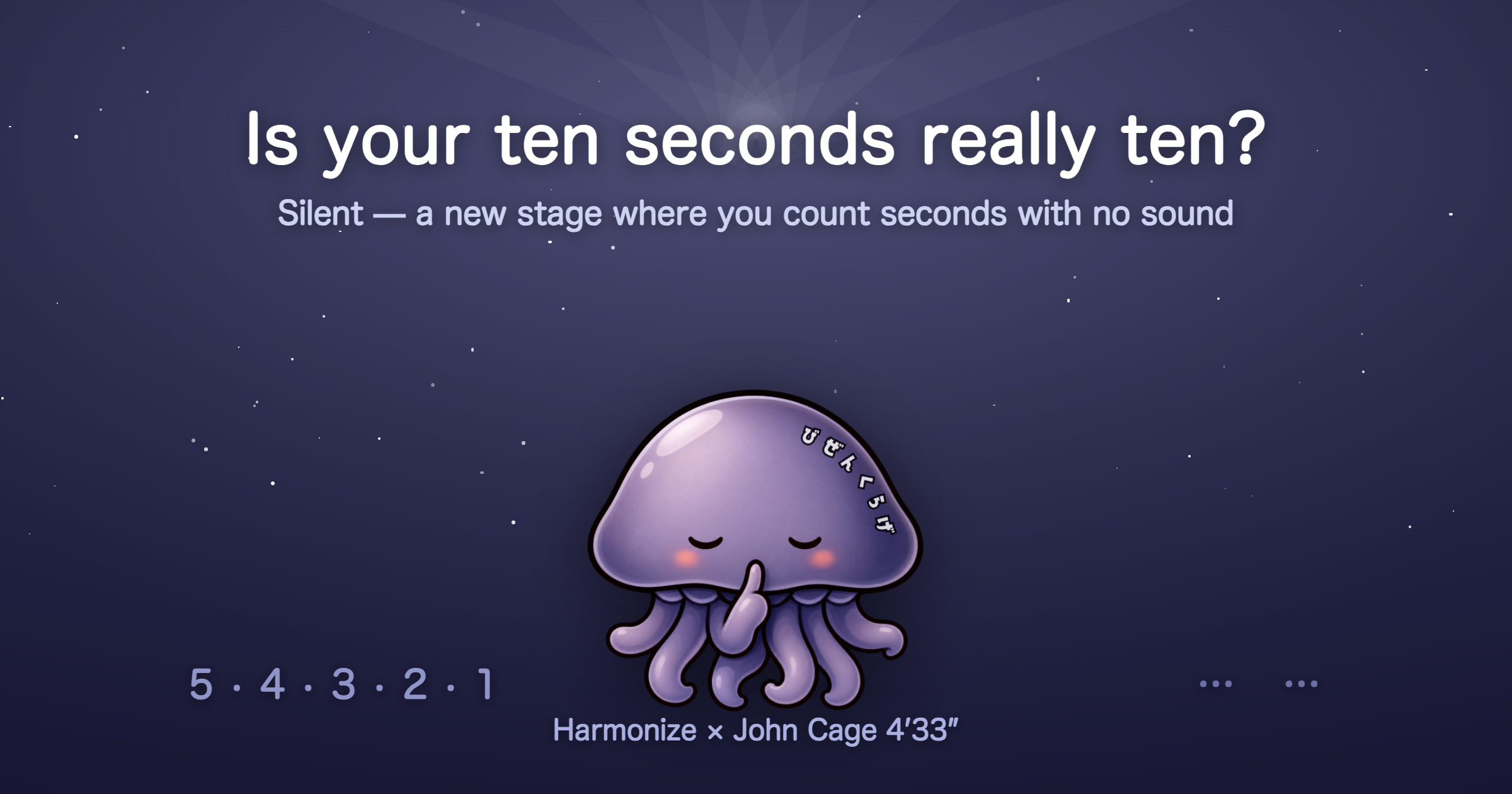
Without looking at a clock, could you measure ten seconds by feel alone?
Try it: close your eyes, count “one, two, three…” up to ten in your head, and stop. Check against a clock and you’ll usually find you were a little too long, or a little too short. It shifts with your mood and how tired you are, too. Your own inner “one second” is not as reliable as you’d think.
I turned that “how far off am I, really?” into something you can actually measure.
A new stage where you count seconds in silence
I develop an ear-training app called Harmonize, and I’ve added a new stage called “Silent.” Unlike the app’s other stages, which are about telling pitches apart, this one tests your sense of time alone.
The rule is simple. A metronome counts down at one-second intervals — “5, 4, 3, 2, 1, GO!” — and then falls completely silent. From there you count the seconds in your head and hit stop the instant you think you’ve reached the target. There’s no clock in sight. All you have is the length of “one second” the countdown put into your body, and your own internal clock. You earn stars based on how close you land. For a ten-second target, you clear it if you’re within one second.
When people think of building a sense of timing, metronome rhythm drills are the usual answer. But a little game like this is another way to sharpen it. There isn’t even a rule to memorize, so it’s fun to compete with family or friends over who comes closest.

By the numbers it looks easy, but once you try, you rarely nail it. And the interesting part is why you don’t.
Your head is noisier than you think
Ten seconds is over in a flash. But as the targets stretch to thirty seconds, then a minute, things change. While you count “one, two, three…” in the silence, you notice your head isn’t quiet at all.
The hum of the air conditioner, a car passing outside, your own breathing. Your attention slips to those outside sounds, and then — “am I speeding up?” “oh, I never answered that email” — stray thoughts keep bubbling up. A task as simple as counting numbers, and your focus breaks right away. You catch the stray thought, return to the count, drift again, return again. Over and over.
At some point it struck me: this is basically meditation. In zazen there’s a method of settling the mind by counting each breath, one at a time. Trying to hold your attention on a single simple thing in a quiet place, drifting and coming back — the inside of a long count was exactly that. The knack for hitting the target comes down to not getting carried off by stray thoughts and just calmly keeping count. A meditation that keeps score, you might say.
Come to think of it, there was a “piece” made of silence
While building the longer targets, I remembered a piece: “4′33″,” released by the composer John Cage in 1952.
It’s a strange one. The score says only “rest.” The performer sits ready at the instrument but doesn’t make a single sound for four minutes and thirty-three seconds. At the famous premiere, the pianist is said to have only opened and closed the piano lid to mark the movements. Whether you can even call it music was argued over at the time, and honestly, “what on earth is this?” is a perfectly normal reaction even now. But Cage was completely serious. With no performance, the sounds we usually tune out rise to the surface instead. What reached the audience at the premiere, so the story goes, was the wind passing outside, rain on the roof, and the “what is going on?” murmur of the crowd. The supposedly silent stretch of time was full of the sounds of the room.
It has no direct connection to the counting game. Still, the way your breath and the sounds outside suddenly feel loud when you go quiet does overlap somewhere. Since I’d remembered it, I made the stage’s final target the same length as the piece: four minutes and thirty-three seconds.
The mushroom jacket
What actually introduced me to this piece wasn’t the sound — it was the jacket. This was back when I was in a band. I loved digging through the avant-garde and experimental shelves at CD shops, and while I of course knew John Cage’s name, what made me reach for this one was the cover before the contents. A black mushroom standing crisp against white — a seriously cool sleeve. It was pretty much a cover-buy. It turned out to be the first in a series called “nova musicha” from the Italian label Cramps Records, and it happened to include a recording of “4′33″.” A record with a silent piece on it, and a mushroom on the jacket. I didn’t get the link at the time, but it stuck in my head ever since.
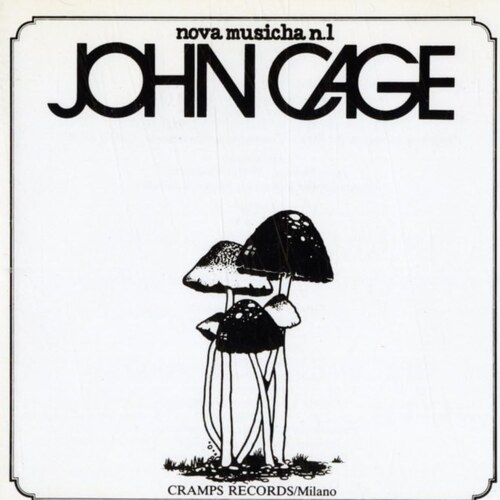
John Cage / Cramps Records (Milano) 1974
John Cage (nova musicha n.1)
The white sleeve with a black mushroom that became the face of the series. Alongside the "4′33″" recording, it gathers Cage's odder pieces — for toy piano, for radio — on a single disc.
Jacket image from Amazon's product listing (John Cage, nova musicha n.1, Cramps Records).
So why mushrooms? I learned later that Cage was enough of a mushroom lover to help found a mycological society, and the mushroom on the jacket was a nod to that playful side of him.
Measure your own “one second”
The stage’s targets start at ten seconds, grow little by little, and end with that 4′33″. Landing four and a half minutes to within one second is something almost no one can do. But once you take it on, you notice your own “one second” is less reliable than you assumed — and that’s oddly enjoyable. In a life that leans entirely on clocks, try checking how far off your body’s sense of time really is. Start with ten seconds.